
Nobody warned you how many nursing courses exist – and how different they all are. Pick the bad one and you spend years regretting it. Pick the right one and your career starts moving fast. This guide exists so you do not have to figure it out alone.
Type of Nursing Course
Diploma and Certificate Courses (Undergraduate Level)
Some students cannot wait four years before earning. Diploma courses were built for exactly that reality – shorter, practical, and they lead to real jobs.
- ANM (Auxiliary Nurse Midwife)
Walk into any rural health centre and there is almost certainly an ANM running the place. The two-year ANM diploma trains you for community health and basic medical management. Villages, primary health centres, and outreach programmes – that is the world ANM prepares you for.
GNM is what most people imagine when they think of a nurse. This programme covers general healthcare, maternity care, and clinical practice together. You come out fit to work as a staff nurse across India.
Degree Courses (Undergraduate Level)
Some students want senior roles with better pay and international choices from the start. Degree programmes are built for that ambition.
- B.Sc. Nursing (Basic)
This is the most respected nursing qualification in India right now. The four-year degree mixes medical theory with real clinical rotations throughout. Leadership roles, government positions, and overseas placements all become accessible.
- Post Basic B.Sc. Nursing
Most GNM graduates do not know this exists – and really should. This two-year course upgrades your diploma to a full bachelor’s degree.
Read Also: GNM Course Full Form, Duration, Eligibility, Fees, Institute, Admission Process and Syllabus
Nursing Course Duration
- B.Sc. Nursing (4 years) includes theory, clinical rotations, and a required internship
- GNM (3 years) focused on training and direct patient care
- ANM (2 years) covers community health and rural medical support
- Post Basic B.Sc. Nursing (2 years) is designed only for licensed GNM diploma holders
Nursing Course Fees
| Course / College Type | Total Fees (Approx.) |
| Government Colleges (4-Year Course) | 40,000 – 2,00,000 |
| Private Colleges (4-Year Course) | 2,00,000 – 10,00,000 |
| Deemed Universities (4-Year Course) | 4,00,000 – 12,00,000 |
| GNM (General Nursing and Midwifery) | 40,000 – 1,50,000 |
| ANM (Auxiliary Nurse Midwifery) | 30,000 – 1,00,000 |
Career Opportunities After Nursing Course
Most nursing brochures skip the honest part – nursing does not lock you into one job. Students who think it means only hospital beds are missing most of the picture.
Prominent Clinical Career Paths
- Staff Nurse (Bedside Care)
Every hospital needs more staff nurses than it actually has. You handle patient care and give medicines. You also help doctors across wards. ICU, emergency rooms, and general medicine – always in demand, everywhere.
- Nursing Superintendent or Chief Nursing Officer
Perform well and stay in the field long enough – this is where you can end up. You manage nursing divisions, set patient care standards, and run staff scheduling. Real power and a salary that reflects it.
- Military Nursing Services (MNS)
Most nursing students never consider this – which is honestly their loss. The Armed Forces recruit nursing officers through competitive exams. You get a rank, housing benefits, and security that private hospitals cannot match.
- Home Care Nurse
Indians are getting older and families are working to manage it alone. Home care nurses visit to calm patients at home regularly. Demand for this role has grown quietly but consistently in recent years.
Non-Clinical and Alternative Sectors
- Industrial or Occupational Health Nurse
Factories, offices, and tech parks all need a trained nurse on-site daily. You manage workplace injuries or run health checks and handle crises when they happen. Normal hours with good pay and no night shifts – many nurses really pick this life.
- Community Health Officer (CHO)
CHOs sit at the heart of India’s public health system. You run primary health sub-centres, execute national health programmes, and lead community sanitation drives. Government-backed and impactful – and underappreciated by most nursing students.
- Medical Scribe or Medical Coder
Not every nurse wants to be at a bedside – and that is completely valid. Medical coders convert treatment records into standardised diagnostic codes at a desk. Hospitals and healthcare networks hire for this role.
- Clinical Research Associate
Pharma companies test new drugs every year and need trained nurses to watch the process. You scan clinical trials and ensure moral bars are followed throughout. Office hours, good pay, and work that shapes medicine.
Academic and Leadership Chances
- Nursing Tutor or Lecturer
Once you hold an M.Sc. and enough experience, teaching becomes a real option. You train the next batch of nurses in classrooms and clinical labs. Many experienced nurses make this switch and find it far more sustainable.
- Nurse Educator
Big hospitals hire nurse tutors to keep their own staff sharp. You run internal training, equipment orientations, and care protocol refreshers. It is behind-the-scenes work – but it directly improves how patients get treated.
Eligibility
Every nursing course has different entry requirements – check yours carefully before applying anywhere.
B.Sc. Nursing
- Minimum age of 17 years by December 31st of the admission year
- Class 12 with Physics, Chemistry, Biology, and English is a must
- At least 45% aggregate marks in PCB from a recognised board
- SC and ST candidates need a minimum of 40% marks
- Clearing entrance exams is required for government and premium colleges
ANM
- Minimum age 17 years, maximum 35 years at the time of admission
- Class 12 in Arts, Science, or Health Care Science Vocational stream is accepted
- English must have been one of your Class 12 subjects
- NIOS and state open school students are also eligible to apply
- Medical fitness at the time of admission is mandatory
GNM
- Class 12 pass with English and a minimum 40% aggregate marks
- Science stream is preferred, though not compulsory at all institutes
- NIOS and state government-recognised open school students are eligible
- Vocational ANM course candidates with 40% marks can also apply
- Registered ANMs with passing marks qualify for direct GNM admission
Admission Process for Nursing Course
Students lose seats every year because they missed one step. Give this your full alert.
- Before anything else, verify your age and Class 12 eligibility for the exact course you want.
- Register on the official state health portal or university website once the application forms open.
- B.Sc. Nursing requires an entrance exam – NEET UG or your state’s nursing CET applies here.
- GNM and ANM skip exams at most institutes – Class 12 marks decide admission directly.
- After the results, log in to online counselling and submit your ranked list of preferred colleges.
- Check the merit list and verify your allotted seat.
- Visit with your marksheets and your school-leaving certificate.
- Clear the medical fitness test, pay first semester fees, and your seat is officially locked.
Why Choose the Institute of Public Health and Hygiene (IPHH) for Nursing Course
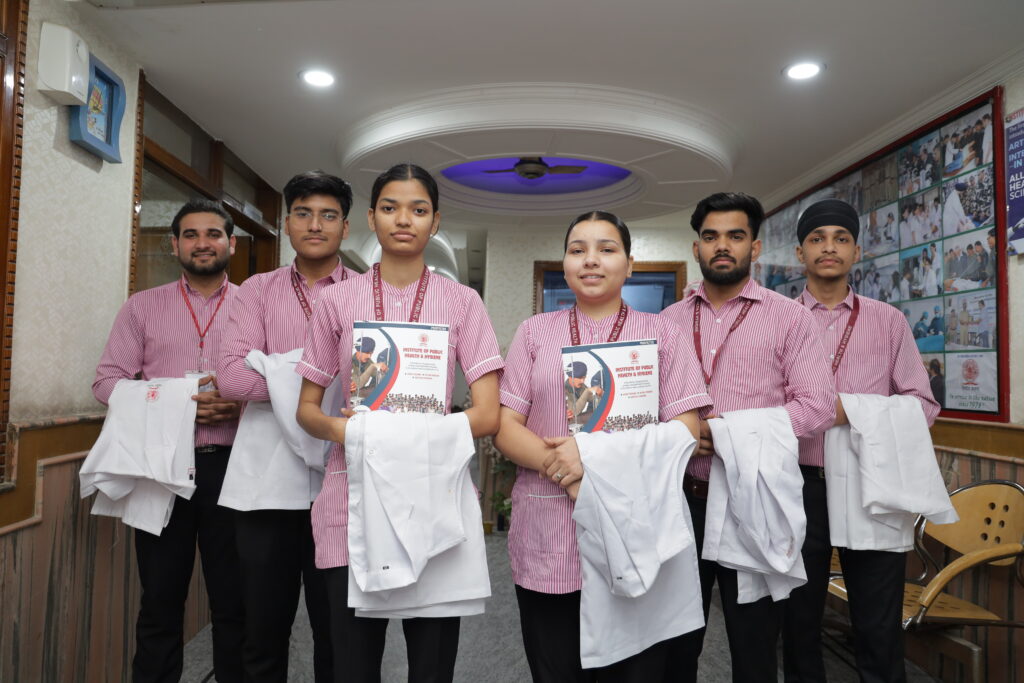
Delhi has no shortage of nursing course institutes. But students keep returning to IPHH – and it is not hard to understand why. The Institute of Public Health and Hygiene in Mahipalpur has trained nurses since 1976. Over 50 years of doing this seriously – that is not a small thing.
- Official Recognition
IPHH’s ANM and GNM programmes carry approval from the Indian Nursing Council and the Delhi State Nursing Council. Your diploma is legally valid for nursing employment anywhere in India. Most students underestimate how much that matters.
- In-House Practical Training
IPHH runs a 24-hour charitable hospital and a specialised polyclinic right on campus. Students start working with real patients on-site. That quick hands-on exposure is really rare among nursing colleges in Delhi.
- Strong Placement Outcomes
IPHH maintains a 90%+ placement rate through an active corporate recruitment cell. Hospitals recruit directly from here. You graduate with real stuff and a genuine shot at a strong first job.
- Prime Transit Location
The campus sits in Mahipalpur. It’s within walking distance of Aerocity Metro Station. Outstation students find safe hostel accommodation nearby too.
Keep visiting Institute of Public Health & Hygiene for such beautiful educational blogs. Follow us on Facebook, Twitter, Instagram, YouTube and Linkedin for regular updates.