
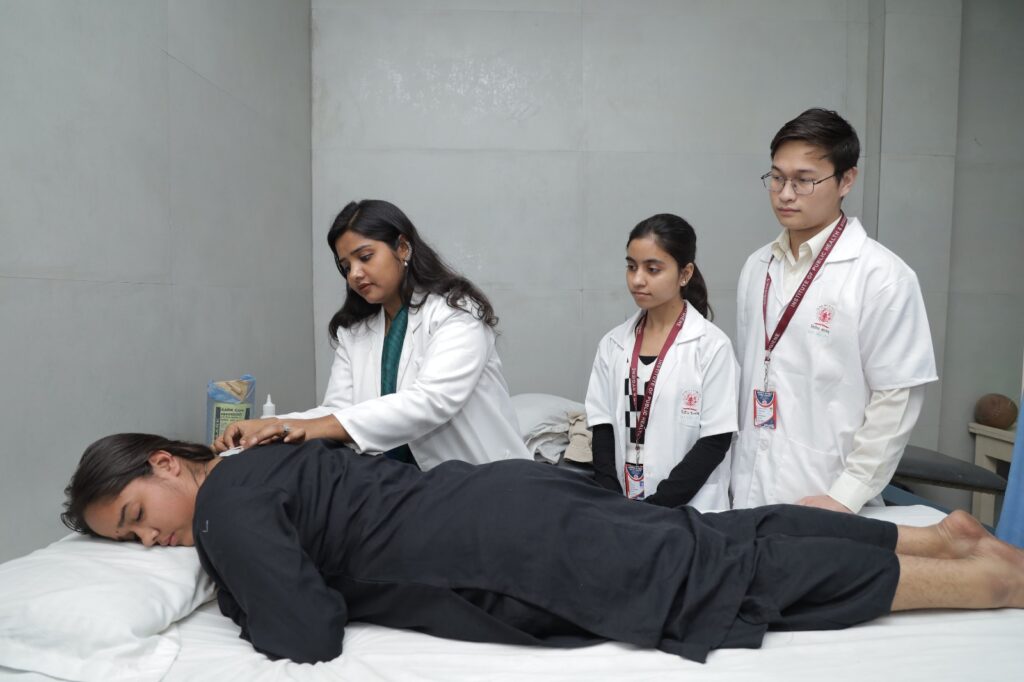
Explore the Diploma in Family Welfare & Child Health to develop essential skills in family care, child health, and community healthcare.
Think about how many decisions a new mother makes in the first year alone. What to feed her baby. When to vaccinate. Who to trust for advice. Behind every one of those decisions, there should be a trained professional she can actually trust. The Diploma in Family Welfare and Child Health prepares you to be exactly that – for mothers, infants, and entire families. This is not a generic healthcare diploma. It is a focused, practical programme built around the real demands of maternal and child health work.
Core Areas of Study in Diploma in Family Welfare & Child Health
The Diploma in Family Welfare & Child Health is not built around textbook theory. Every subject connects directly to real situations you will face – whether you end up in a hospital ward, a rural health centre, or a community programme.
- Maternal and Reproductive Health
Pregnancy is not a single event – it is a long process that needs careful monitoring from start to finish. You learn real care and safe delivery practices. The goal is steady, informed support across every stage – not just the dramatic moments when things go wrong.
- Pediatric Nutrition and Growth
A child’s first few years shape more about their long-term health. You learn to track developmental landmarks and spot malnutrition early. Manage nutritional flaws in infants and young children. The earlier these crises are identified, the better the results. Catching these problems in the first year makes a genuine, measurable difference to long-term outcomes.
- Preventive Pediatrics and Immunization
Most childhood illnesses are preventable – and that is exactly the point of this module. You learn to administer routine immunization schedules correctly and manage infections in newborns. Common conditions like diarrhea and respiratory tract infections are also covered in practical depth.
- Family Welfare Programs
Healthcare does not exist in a vacuum – government policies and schemes shape what communities can actually access. You study reproductive child health policies, population dynamics, and how to work within existing government welfare frameworks. Understanding these systems helps you navigate them – and serve families far more effectively on the ground.
Bridging Academic Training with Next-Gen Medical Skills
Healthcare employers today want more than clinical facts. They want experts who connect with people and read cases accurately. You can use data to make better decisions. This diploma builds all three – not through theory alone, but through the actual work.
- Radical Empathy and Active Listening
Working with a new mother or a sick infant is not the same as working with an adult patient. They can clearly clarify their signs. Read pain signals in parents and build trust fast. This diploma puts you in those situations regularly and early. That repeated exposure is genuinely irreplaceable – no classroom exercise can substitute for it.
- Cultural Competence and Health Equity
Family planning and child food are all deeply shaped by cultural beliefs. What one family feels is normal care and another may see it very differently. You learn to deliver accurate medical guidance while genuinely respecting those differences. That balance is harder than it sounds. Correcting harmful misinformation without alienating the family is a skill most professionals never formally learn – this diploma teaches it directly.
- Data Literacy and Health Informatics
Digital growth charts, immunization logs, and infant mortality metrics are all part of modern child healthcare. You learn to navigate these tools and use the data to improve how welfare programmes run. Numbers in child health are never just administrative. They directly shape the interventions that save lives – and you need to be comfortable using them.
Diverse Career Paths and Employment Opportunities
Graduating with Diploma in Family Welfare & Child Health opens doors across public and private healthcare – clinics, NGOs, government departments, and community centres all hire from this qualification. The range of roles is wider than most students expect. Here is where most graduates actually end up.
Family Welfare Officer
This role puts you at the centre of reproductive and child health programming. It is a leadership-oriented role that asks for both clinical facts and vital executive ability. The combination is what makes good family welfare officers genuinely hard to replace.
Pediatric Care or Maternity Assistant
You help gynecologists and pediatricians in clinical sets daily. Tracking maternal vitals and watching newborn health. Assisting with systems is all part of this job. It is hands-on and fast-paced work that builds strong clinical instincts.
Community Health Educator
Some of the most vital healthcare work happens far from hospitals. Community health tutors run workshops for rural and underserved women on prenatal food. Neonatal care and contraception are also vital. You take difficult medical data and make it free to people who need it most.
NGO Child Health Coordinator
Organisations like UNICEF run plans targeting child survival and maternal welfare. Coordinators work on field operations and track programme results. This ensures help reaches the right communities. If ground-level impact matters to you – this role gives it directly.
Diploma in Family Welfare & Child Health Admission Requirements and Academic Eligibility
Before you apply for Diploma in Family Welfare & Child Health check these basics carefully. Needs can vary slightly between institutes but these are the public ideals most follow.
- Educational Background
Class 12 completion with a science background is the standard starting point. Biology, Chemistry, and Physics are the preferred subjects for most programmes. A solid science foundation helps you engage with the clinical content comfortably from the very beginning of the programme.
- Alternative Criteria
Not every applicant comes straight from Class 12. Some institutes accept practicing nursing professionals and trained midwives who want to specialise further. If you already have clinical experience, that background actually works in your favour during admission.
- Programme Duration
Most versions of this diploma run for one to two years. A mandatory practical clinical internship is usually built into that timeline. That internship is not an optional extra time. It is where the real learning happens – and where most graduates build their first professional connections in the field.
Why Choose the Institute of Public Health and Hygiene (IPHH) For Diploma in Family Welfare & Child Health
There are plenty of institutes offering Diploma in Family Welfare & Child Health in India. But IPHH in New Delhi keeps coming up in conversations – and for specific reasons, not just reputation. Founded in 1976, it has spent fifty years figuring out what actually works in healthcare education. Here is what makes it worth considering seriously for this diploma.
- No Entrance Exams Required
Competitive national tests like NEET stop a lot of genuinely capable students before they even begin. IPHH gives you direct admission based on your qualifying board marks. No entrance exam pressure, no months of extra preparation – just a straightforward merit-based process that gets you started faster.
- Dedicated Medico-Legal School
IPHH runs a distinct School of Allied Health, Forensic and Medico-Legal Sciences. Clinical patient care and law enforcement workflows are taught together – not in separate silos that never speak to each other. That integration gives graduates a much broader professional foundation than most diploma programmes provide.
- Highly Practical Training
Reading about evidence collection and actually doing it are two very different experiences. IPHH uses mock crime scene setups and hands-on laboratory workshops throughout the programme. You practise fingerprinting, evidence handling, and legal documentation in realistic conditions – before you ever face a real case.
- 50-Year Academic Legacy
Being founded in 1976 is not just a number on a brochure. It means founding hospital alliances. Well-tested clinical training paths and a graduate network that employers actually admit. Five decades of consistent training mean the systems here genuinely work.
- Niche Diploma Choices
Generic programmes produce graduates who look the same on paper. IPHH offers focused tracks like Clinical Forensic Allied Health Practice and Forensic Toxicology and Clinical Diagnostics. You choose the direction that fits your specific goals – and you graduate with targeted, marketable skills rather than a broad qualification that says very little.
Keep visiting Institute of Public Health & Hygiene for such beautiful educational blogs. Follow us on Facebook, Twitter, Instagram, YouTube and Linkedin for regular updates.