
BMLT vs BSc Nursing: Compare eligibility, course duration, career scope, salary, and job opportunities to choose the right healthcare career after 12th.
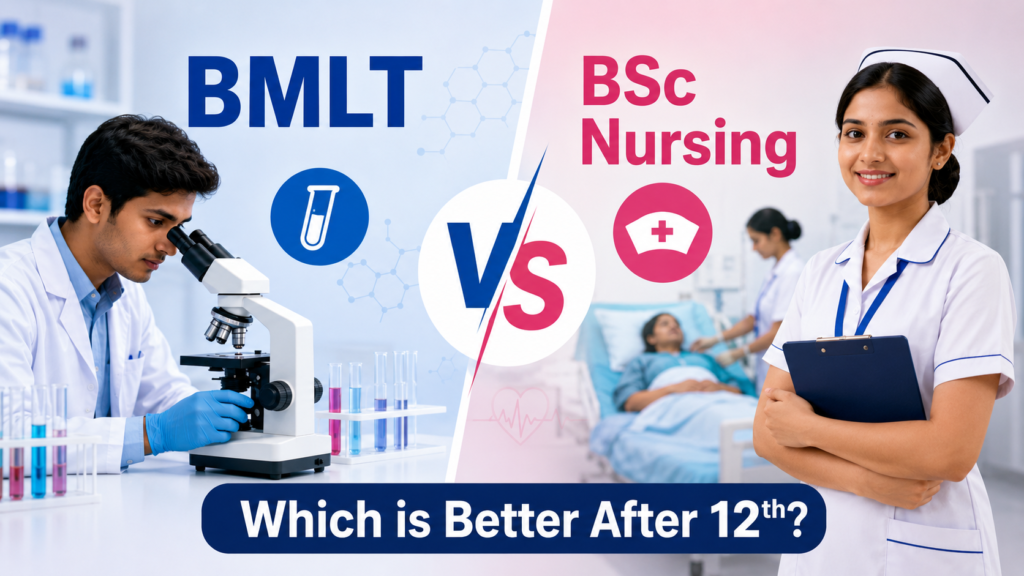
Two courses. Both medical. Both have real futures attached to them. But they take you in completely different directions – and that gap matters far more than most students realise before they apply. BMLT trains you to work behind the scenes in diagnostic labs. Analysing samples and making the data that doctors rely on. BSc Nursing puts you at the patient’s side. You are involved in their care and recovery. Neither is better in any absolute sense. The right choice depends entirely on who you want to be as a healthcare professional – and this guide walks you through exactly that decision.
Understanding BMLT
BMLT stands for Bachelor of Medical Laboratory Technology. It is a 3-year undergraduate degree that goes deep into laboratory sciences.
Basic Subjects:
- Clinical Diagnostics
- Pathology
- Microbiology
- Biochemistry
- Haematology
- Laboratory Management
You also learn advanced diagnostic methods and research processes. The work happens mostly in labs – analysing samples and running tests. Having the data that doctors use to make care decisions. If you are someone who likes working with science and technology over direct patient interaction, BMLT fits that choice naturally.
Understanding BSc Nursing
BSc Nursing is a 4-year course that puts you at the centre of patient care. You learn disease prevention and health promotion. Clinical policies and emergency response are included. Classroom learning runs alongside extensive hospital-based training throughout the four years. By the time you graduate, you have spent real hours in real wards with real patients. If direct human care feels like your calling, this is the degree that builds the foundation for it properly and practically.
BMLT vs BSc Nursing: Course Curriculum
The subjects each course covers reveal exactly how different these two paths are from each other. Understanding this gap before you apply saves a lot of regret later.
BMLT Subjects
BMLT gives you deep technical knowledge across the full range of laboratory sciences.
- Clinical Biochemistry
- Haematology
- Histopathology
- Microbiology
- Cytology
- Molecular Biology
- Immunology
- Blood Banking
- Laboratory Management
BSc Nursing Subjects
BSc Nursing focuses on everything that happens when a patient needs care.
- Patient care and clinical procedures
- Emergency care and ICU management
- Community healthcare
- Nursing ethics
- Surgery assistance
- Hospital administration
Hospital-based practical training runs heavily throughout the entire programme.
BMLT Vs BSc Nursing Fee Comparison
Fees vary significantly depending on where you study. Here is a realistic picture across institution types.
Government Colleges
- BMLT: ₹20,000 – ₹2 lakh
- BSc Nursing: ₹10,000 – ₹2.3 lakh
Private Colleges
- BMLT: ₹2 – ₹5 lakh
- BSc Nursing: ₹2 – ₹6 lakh
Deemed/Private Universities
- BMLT: ₹3 – ₹6 lakh
- BSc Nursing: ₹3 – ₹8 lakh
Fees shift based on location, infrastructure, scholarships, and admission category. Always check the specific institute before making assumptions. Government colleges remain the most affordable entry point in both courses by a significant margin – and the quality of training at many of them is genuinely strong.
Higher Education Options
Neither BMLT nor BSc Nursing is a dead end – both open doors to postgraduate study and specialisation.
After BMLT
- MSc Medical Laboratory Technology
- MSc Microbiology
- MSc Biochemistry
- MSc Haematology
- MBA Hospital Administration
- Master of Public Health (MPH)
- Clinical Research Programmes
- PhD
After BSc Nursing
- MSc Nursing
- Nurse Practitioner Programmes
- MBA Healthcare Management
- Master of Public Health (MPH)
- PhD Nursing
Career Scope After BMLT Vs BSc Nursing
Both courses lead to genuine employment – that is not the question. The real difference is in where you end up working and what your daily work actually looks and feels like on the ground.
BMLT Career Roles
- Medical Laboratory Technologist
- Laboratory Manager
- Blood Bank Technologist
- Microbiology Technologist
- Histopathology Technician
- Molecular Diagnostics Technologist
Top recruiters: Hospitals, diagnostic laboratories, blood banks, research institutes, pharmaceutical companies, and public health laboratories.
BSc Nursing Career Roles
- Staff Nurse
- ICU Nurse
- Operating Theatre Nurse
- Emergency Nurse
- Community Health Nurse
- Nursing Officer
- Military Nurse
- Nursing Educator
Top recruiters: Government hospitals, private hospitals, nursing homes, NGOs, defence hospitals, and international healthcare organisations.
Salary Comparison BMLT vs BSc
Here is how earnings typically look across both courses as experience builds.
Freshers
- BMLT: ₹3 – ₹5 LPA
- BSc Nursing: ₹3.5 – ₹6 LPA
3–5 Years of Experience
- BMLT: ₹5 – ₹7 LPA
- BSc Nursing: ₹6 – ₹9 LPA
5–10 Years of Experience
- BMLT: ₹7 – ₹12 LPA
- BSc Nursing: ₹8 – ₹15 LPA
BSc Nursing consistently edges ahead in salary at every experience level. BMLT still offers solid growth – particularly in specialised diagnostic, pharmaceutical, and research roles where technical depth is valued.
BMLT vs BSc Nursing: Which Is Better After 12th?
There is no universal answer here – and anyone who gives you one is wrong. The right course is simply the one that matches how you really want to spend your working days.
Choose BMLT If You
- Prefer working with science, data, and diagnostic technology over direct patient interaction
- Plan to seek higher studies in laboratory sciences or research
- Want to move into research or the medicine industry roles
- Are genuinely curious about long-term growth within a specialised technical field
Choose BSc Nursing If You
- Want to work with patients and be part of their care
- Have strong talking skills and real empathy for people
- Can handle high-pressure clinical settings and handle stress
- Wish to build a long-term career in hospitals and healthcare
Why Pick the Institute of Public Health and Hygiene (IPHH)
There are many institutes in Delhi. IPHH keeps coming up because it has genuinely earned that reputation over decades – not manufactured it through marketing. The Institute of Public Health and Hygiene in Mahipalpur, New Delhi has been training paramedical and nursing professionals since 1976. That is over fifty years of doing this seriously. Here is what actually sets it apart.
- Official Recognition
IPHH’s ANM and GNM programmes carry approval from the Indian Nursing Council. The Delhi State Nursing Council also recognises them officially. Your diploma is legally valid for nursing employment across every state in India. That recognition matters far more than most students appreciate at the time of admission – it opens government recruitment doors that unrecognised diplomas simply cannot.
- Decades of Academic Legacy
Since 1976, IPHH has consistently trained paramedical and nursing professionals across a wide range of specialisations. Five decades of experience mean the institute has seen every challenge this field throws up – and built systems that handle them. That track record is not something a newer institute can replicate quickly.
- In-House Practical Training
IPHH runs its own 24-hour charitable hospital and a specialised polyclinic right on campus. Students interact with real patients from early in the programme – not just in their final year. That quick and on-site clinical exposure is really rare among Delhi nursing institutes. It makes a visible and measurable difference in how safe and qualified graduates feel when they step into their first real job.
- Strong Placement Outcomes
IPHH maintains a 90% + placement rate through a dedicated corporate recruitment cell. Hospitals like Max Healthcare, Fortis, and Medanta recruit directly from here, consistently year after year. You graduate with a recognised qualification and an active placement network already working in your favour.
- Prime Transit Location
The campus sits in Mahipalpur, New Delhi – within walking distance of Aerocity Metro Station. Getting there every single day is easy – whether you commute locally or travel in from another part of the city. For students coming from outside Delhi, safe and accessible hostel accommodation is available close to the campus.
Keep visiting Institute of Public Health & Hygiene for such beautiful educational blogs. Follow us on Facebook, Twitter, Instagram, YouTube and Linkedin for regular updates.