
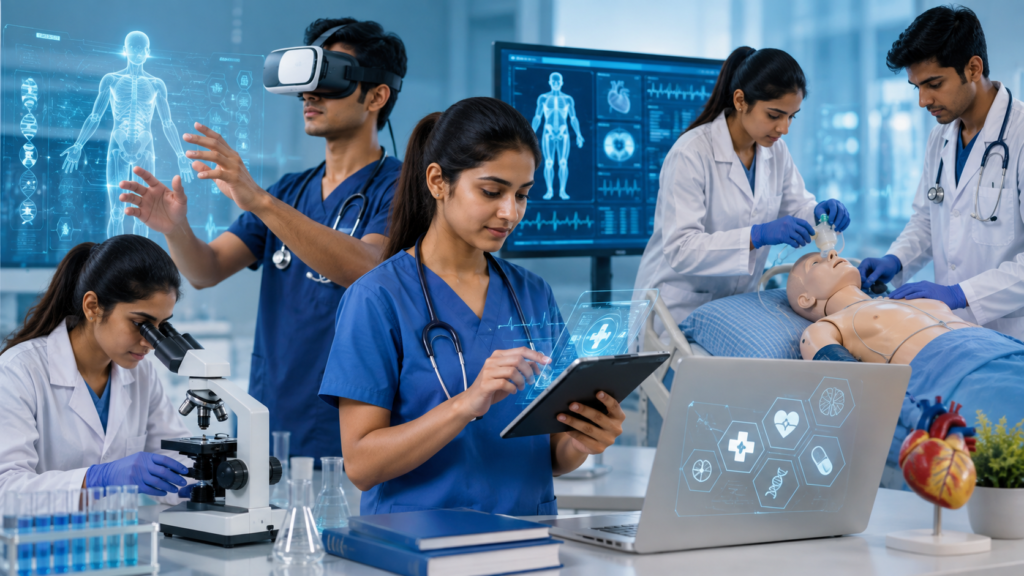
Nobody talks about this enough – getting into healthcare is only half the challenge. Staying suitable once you are inside is the harder part. The skills clinics needed ten years ago are simply not the same ones they need today. Anatomy and pharmacology will always matter. They are no longer enough on their own. Future healthcare skills belong to students who start building the right skills now – before they even walk into their first ward.
1. AI and Digital Health Fluency
AI is already here and working. Hospitals use it for diagnostics. Clinics use it for patient triage. Insurance firms use it to flag high-risk cases before signs appear. Skipping it is not a choice anymore.
You do not need to code or build algorithms. That is not the point. The point is knowing how to work alongside these tools without feeling lost or suspicious of them.
- The Core Skill
Learn how clinical decision-support software works and what it is actually doing. Know its limits just as much as its forces.
- The Application
Guide telehealth platforms with trust. Read AI-generated diagnostic tips critically. Save patient data by following strict cybersecurity protocols at all times.
2. Health Informatics and Genomic Literacy
Medicine used to run on instinct and experience. Now it runs on data – enormous, fast-moving amounts of it. Electronic Health Records and predictive analytics are part of daily clinical work today. Students who cannot engage with this data will find themselves behind from day one.
Students who cannot read or use health data will struggle. Is it that straightforward.
- The Core Skill
Learn to gather, read, and act on complex health data. Turn numbers and patterns into real patient care decisions.
- The Application
Use predictive things to spot high-risk patients before things go wrong. Read basic genomic profiles to support personalised treatment plans. Skills required in healthcare that lead to data literacy are becoming really vital.
3. Interdisciplinary Collaboration
The lone expert who operates independently is mostly a thing of the past. Modern hospitals run on teams everyone working on the same patient together.
If you cannot speak across those groups clearly – patient care suffers. It is not a soft skill anymore. It is a clinical necessity.
- The Core Skill
Speak cleanly across both clinical and non-clinical teams. Drop the jargon when the case calls for plain wording.
- The Application
Work comfortably with biomedical engineers, hospital administrators, and social workers. Focus every collaboration on one thing – better outcomes for the patient in front of you.
4. Cultural Competence and Health Equity
India is mixed and the world is more related than it has ever been. The patients you treat will come from various places and financial situations. What works for one person may fully fail for another. Feting everyone the same way is not the same as treating everyone well.
Knowing the cultural context is good. It directly affects whether patients follow treatment plans or not.
- The Core Skill
Recognise and respect cultural differences, language barriers, and economic limitations in healthcare settings. Adjust your approach without compromising medical standards.
- The Application
Modify treatment communication to fit a patient’s cultural background. Actively work toward reducing care gaps in underserved communities. This skill is central to all future healthcare skills worth building.
5. Radical Empathy and Active Listening
Here is something no AI will ever replicate – a patient feeling genuinely heard by another human being. Machines can diagnose faster than any doctor. Machines cannot sit with someone scared and make them feel less alone. That gap is exactly where human healthcare experts become special.
Empathy is not just about the heart. It is a clinical tool that boosts cure keeping and builds trust. Patients who trust their providers follow their advice. That leads to better health outcomes.
- The Core Skill
Connect with patients on a moral level. Read non-verbal cues. Hear without rushing or looking at a screen.
- The Application
Build patient trust through constant and careful care. Catch what patients cannot or will not say directly. Deliver comfort that healthcare skills combined can never fully replace.
6. Crisis Management and Agile Adaptability
COVID-19 showed the entire world what healthcare under pressure really looks like. Systems collapsed. Protocols changed weekly. Professionals had to learn new procedures overnight while still treating patients.
That kind of disruption will happen again. The question is whether you will freeze or adapt.
- The Core Skill
Stay mentally flexible and really calm when everything around you is changing fast. Make clear findings under stress without losing sight.
- The Application
Switch to new safety protocols quickly when a public health emergency demands it. Pick up unfamiliar clinical technology fast when the situation requires it. Adaptability is one of the most underrated skills in all healthcare careers 2026 and clinical roles alike.
7. Emotional Resilience and Burnout Prevention
This one does not get enough attention in most healthcare training programmes – and that is a real problem. Burnout is not a personal weakness. It is a systemic issue that this field has not yet solved properly. Nurses leave. Doctors leave. Not because the work is not meaningful, but because the emotional weight piles up and nobody taught them how to carry it.
If you do not build resilience deliberately, the job will build it for you – usually the hard and costly way.
- The Core Skill
Grow real psychological coping tricks and set firm limits between skilled demands and private life. Know the early signs of heart fatigue before they become a crisis.
- The Application
Use peer support systems when the work gets heavy. Don’t try to take it alone – that is how burnout starts. Practice regularly and not just when you are already tired. Skills required in healthcare are rarely taught, but every professional eventually needs them.
Why Choose the Institute of Public Health and Hygiene (IPHH) for Healthcare Skills
A lot of institutes teach healthcare. Fewer actually prepare you for where healthcare is going. IPHH in Mahipalpur, New Delhi has been doing this since 1976, and the way it teaches has kept up with where the field is heading. Here is why students who are serious about future healthcare skills keep choosing it.
- No Entrance Exams Required
Competitive entrance exams stop a lot of capable students before they even start. IPHH gives you direct admission based on your qualifying board marks. No NEET pressure, no specialised forensic entrance tests – just a straightforward merit-based process.
- Dedicated Medico-Legal School
IPHH runs a separate School of Allied Health, Forensic and Medico-Legal Sciences. It trains you where healthcare skills genuinely intersect – not just in theory, but in practice. Clinical care and law enforcement workflows are taught together from day one.
- Highly Practical Training
Reading about crime scene evidence collection and actually doing it are very different things. IPHH uses mock crime scene setups and hands-on lab workshops throughout the programme. You practise fingerprinting, evidence handling, and legal documentation in realistic conditions before you ever face a real case.
- Niche Diploma Choices
Generic programmes produce generic graduates. IPHH offers focused tracks like Clinical Forensic Allied Health Practice and Forensic Toxicology and Clinical Diagnostics. You choose the direction that fits your career goals – and you graduate with specific, marketable skills. That focus matters when you are competing for roles in healthcare careers 2026 that demand genuine, specific expertise – not just a general qualification.
Keep visiting Institute of Public Health & Hygiene for such beautiful educational blogs. Follow us on Facebook, Twitter, Instagram, YouTube and Linkedin for regular updates.